 Read through the visions in the second half of the book of Daniel (Daniel 7-12). Is there anything here that seems key to the survival of the Jewish people? How would having the book of Daniel have helped the Jewish people go through difficult times, e.g., the time of Antiochus Epiphanes?
Tuesday, April 19, 2022
Apocalyptic Visions of Daniel (extra credit)
Read through the visions in the second half of the book of Daniel (Daniel 7-12). Is there anything here that seems key to the survival of the Jewish people? How would having the book of Daniel have helped the Jewish people go through difficult times, e.g., the time of Antiochus Epiphanes?

Malachi (extra credit)
 Read all of Malachi. What is the condition of the Jewish people as he writes? What are the particular problems he addresses? How is the situation different from that addressed by earlier prophets, e.g., Isaiah and Jeremiah? What keys to Jewish survival do you see here?
Haggai and/or Zechariah (extra credit)
 Skim through Haggai and/or Zechariah. Note the problems in the Jewish community that these two prophets address. How would their prophetic message have helped in rebuilding Jerusalem and in helping reforms among the Jewish people? What aspects of their teachings might have helped the Jewish people survive even after the temple was destroyed and the Jews were removed from their land again?
You may turn this into two "extra credit" blogs if you like: one entry on each book.
Nehemiah (extra credit)
 Skim through Nehemiah. Note that much of this book is Nehemiah’s account of his own role in helping the rebuilding of Jerusalem and in restoring the Jewish people. Note the problems he faces. What does Nehemiah seem proud of in terms of his own record/conduct? What obstacles does he face? What seems to be his motivation?
Proverbs (Extra Credit)
 For your final exam, I will be combing what are usually study
questions 3 and 4. I'll be asking your for comments on this
generalization:
The Hebrews may not have added
much to human knowledge, but their
contributions to human wisdom are very impressive. Especially important are their explorations
of
the problem of evil
I'll be giving you a lot of
material on the final part of the generalization, but you can if you
like spend some time dealing with the "wisdom" books of the Bible
including (especially) Proverbs and Ecclesiastes.
For extra credit, please read the first chapter of Proverbs and skim the rest of the book. Choose three proverbs that you think is a particularly good examples of Hebrew contributions to human wisdom. Explain your choice, and note what makes each Proverb particularly memorable.
Ezra (Extra Credit)
 Read Ezra Ch. 1 and Ch. 3-7. What difficulties do the Jews face as they try to rebuild Jerusalem and the temple? What helps them overcome these difficulties? Note especially the role of leaders like Zerubbabel, Jeshua, Haggai, Zechariah, and Ezra himself. Also note the contrasting attitudes of Persian leaders, e.g., Cyrus and Artaxerxes.
Thursday, April 7, 2022
Ecclesiastes (Extra Credit)
 For your final exam, I will be combing what are usually study questions 3 and 4. I'll be asking your for comments on this generalization:
The Hebrews may not have added much to human knowledge, but their contributions to human wisdom are very impressive. Especially important are their explorations of the problem of evil
.
I'll be giving you a lot of material on the final part of the generalization, but you can if you like spend some time dealing with the "wisdom" books of the Bible including (especially) Proverbs and Ecclesiastes.
For extra credit, share your reactions to the prompt here:
For some people, Ecclesiastes is their favorite book in the entire Bible. Others wonder why it is in the Bible at all. What's your reaction? Did you find this book more or less enjoyable/valuable than the other books you've read for this class? Any particular important contributions to human wisdom you see here?
Habbakuk (Extra Credit)
 The Septuagint translation contains some extra material not in the Hebrew text of Daniel. Daniel Chapter 14 of the LXX (see link below) has a story about a very brief meeting of Daniel and Habakkuk while Daniel is in the lion's den.
Suppose Habakkuk really did have a chance to visit Daniel very briefly--long enough only to leave him a verse or two as advice. Cite a couple of verses from Habakkuk that might have been particularly good for Daniel to hear while he was in the Lion's den. Explain why these verses would be good for Daniel, or for others in similar difficulties.
Link: Daniel vs. Bel and the Dragon (and the visit from Habakkuk).
Daniel and the Problem of Evil
 Please read Chapters 1-7 and 12 of Daniel carefully. Skim the rest.
Daniel is a favorite "Sunday school" book, a book filled stories the lend themselves well to teaching children. But Daniel is an adult book as well. What do you think is the most important or most interesting lesson Daniel teaches to adults? How does the book add to human wisdom?
The Book of Job
 Please read through Chapters 1-5, 19 and 37-42 of the Book of Job. In addition to addressing the problem of evil, what other wisdom does Job offer? Cite a verse or two you think would be particularly good to include in an anthology of ancient wisdom, and explain why you think this verse or these verses are particularly worth including.
Wednesday, April 6, 2022
Ezekiel
 I am planning on covering *all* of Ezekiel in one easy class on on Thursday, April 10. Please read my study questions on Ezekiel. Then read Chapters 1-12, 33, and 37 of Ezekiel itself.
What do you find here that suggests that Ezekiel's message was a burden? Are there any passages that particularly well reflect hope, beauty, faith in the triumph of justice, or anything else that makes that burden worth bearing?
Thursday, March 31, 2022
Jeremiah Chapters 1-28
 Please read through my Jeremiah study questions and then as much as you can of the first half of Jeremiah. Be sure to read Chapters 16, 20, 23, and 28.
Suppose you are asked to help prepare an anthology of great quotations from the ancient world. There are going to be some Jeremiah quotes, and you get to make suggestions. Of all of Jeremiah's many quotable line, suggest two or three you think particularly worth including.
Thursday, March 24, 2022
Readings from Isaiah
 Please read Isaiah 1, 6-9, 36-39, and any two or three chapters of your choice from Isaiah 40-66.
Suppose you are asked to help prepare an anthology of great quotations from the ancient world. There are going to be several Isaiah quotes, and you are asked for your suggestions.
Of all of Isaiah's many quotable lines, what *two* would you single out as the best for inclusion in the anthology? What would you say to the other compilers to persuade them that these are the quotes to include?
Wednesday, March 23, 2022
Amos
 Please read these study guide questions on Amos and Isaiah and then all nine chapters of Amos. Choose one or two of the first 13 study guide questions and suggest an answer to that question/those questions here..
I would be particularly interested in your comments on Amos' use of imagery. Do you find any of Amos' images particularly effective? Particularly disturbing?
Wednesday, March 9, 2022
II Kings 1-10, 17
 Please read Chapters 1-10 of II Kings. Please read also Chapter 17. We'll be focusing on two themes: whether or not the story of Elisha has the makings of tragedy and whether or not the story of the nation of Israel as a whole has the makings of tragedy.
Greek tragedies stand out, not only for their overall message, but also for the many "gems" of wisdom and beautifully phrased insights into the human condition included in the choral passages. Please cite here one or two lines from the assigned chapters that seem to you equivalent in function/form to the choral sections of Greek tragedies. If you don't think it particularly useful to view II Kings as tragedy, cite instead a line or two that you consider a good example of historical/biographical insight, or that reflects the prophetic character of the book.
Friday, March 4, 2022
I Kings 12-22
Please read Chapters 12-22 of I Kings, the sections on Elisha and Ahab. Which of the stories/characters in I Kings 12-22 interests you the most? Does this story lend itself to good tragedy? Or is does it seem more like history, biography, or prophecy rather than tragedy?
Wednesday, March 2, 2022
I Kings 1-11
 Please read my study questions on I Kings and then I Kings, Chapters 1-11.
Does it seems to you that the I Kings account of Solomon has in it the makings of a good tragedy? Or is the I Kings account better viewed as history, biography, or prophecy rather than as tragedy?
Thursday, February 24, 2022
II Samuel
 Please read my II Samuel study questions and then as much as you can of II Samuel. It would be really nice if you could read (or at least skim) the whole book.
The key figure here is David, and II Samuel will take us almost to David's death. If you have time to also read Chapter 1 and 2 of I Kings, you'll see the end of David's story.
Choose one or more of the study guide questions linked above and suggest an answer/answers to that question/those questions.
If you prefer, list two questions of your own about II Samuel, questions you think would lead to good discussion.
I Samuel Discussion II (Due Thursday, February 27)
 For Thursday, February 27, please read/review I Samuel 1-14 and then finish up the book (reading through Chapter 31).
Please think about the following question and add your comments to the post below.
Does I Samuel seem to you to be best classified as history, prophecy, biography, tragedy, or something else entirely? Cite one passage/story in this book that you think particularly supports your view of this book.
Thursday, February 17, 2022
I Samuel
 Please read through my study questions for I Samuel and then through I Samuel itself. Which of the many episodes in this book do you find the most tragic? What is the lesson to be learned from this story? Alternatively, choose an episode/incident you find uplifting, and explain why you like this particular passage.
Thursday, February 10, 2022
Joshua and Judges
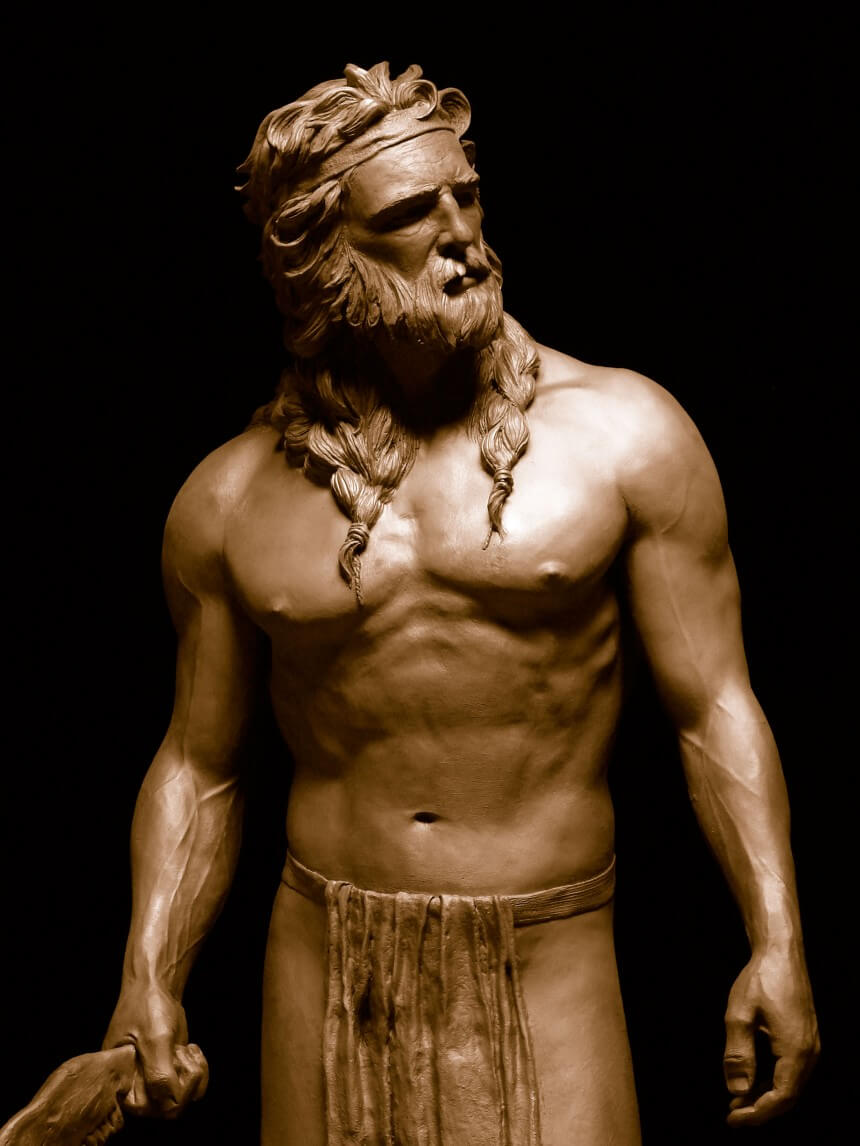
Please also read the story of at least one of the following Judges: Ehud (Judges 3), Deborah (Judges 4-5), Jephthah (Judges 11-13), or Samson (Judges 14-16).
The first question for your next midterm exam asks you to talk about the figures in Joshua and Judges as "heroes with warts" or "warts with a hero." You might think about that question as you do the readings.
For the post here, evaluate the strengths and weaknesses of whatever figure in these chapters you find the most interesting (Joshua, Gideon, Deborah, Abimelech, etc.) What do you think of this person? What's admirable/not so admirable? A hero with warts? A wart with a hero? For extra credit, you can comment on an additional figure. Please put "extra" comments in a separate post.
By the way, the picture here is Ben Victor's statue of Samson. Ben took my History 413 class here at NSU quite a few years ago. And, just in case you are wondering, he didn't use a younger version of me as his model for Samson.
Tuesday, February 1, 2022
Deuteronomy Discussion II
 Please read through as much of you can as the remaining chapters of Deuteronomy. Cite here one law you think is particularly good--part of what makes Deuteronomy a fine law code. Cite also one law that you find disturbing, difficult or hard to understand--something that one might *not* (at least at first) think of as part of a particularly good law code.
Remember that there is an exam coming up next Tuesday! I may be revising the study guide slightly. Be sure to check the online study guide as you prepare for the exams.
The study guide lists IDL I, II, and III as potential ID terms. The two laws you cite here would probably make good "IDL's" (Interesting Deuteronomy Laws). The selections other students choose would probably work well too.
Deuteronomy--Discussion I
 In Deuteronomy, as in Exodus, the writer gives us a lot of preliminary material before he gets to the actual “rules and regulations” of the law. Please read through the Deuteronomy study questions, then read carefully the first six Chapters of Deuteronomy. I'd like you also look through the various "statute" laws of the chapters 7-15, but you don't need to read that material quite so carefully.
What is there in this preliminary material (Chapters 1-6) you find particularly, interesting, important, or worth discussing in class? In what way does this material show Deuteronomy to be a particularly fine law code or something more than just a law code?
Saturday, January 22, 2022
Exodus 32-34

Exodus--Discussion I
 Please read my Exodus study questions and then Chapters 1-20 of Exodus.
Your third midterm study question asks you to address the idea that Exodus is an example of the Torah being the finest law code that the ancient world produced because it is more than just a law code. We finally will get to "statute" law in Exodus, but, first, we've got 20 chapters that give more background to the law. Please comment here on one or two things you see in these chapters that strike you as particularly important as background to a law code or things that show the Torah to be something more than just a law code.
Thursday, January 13, 2022
Genesis 25-50
 "Torah" can rightly translated as "law," but the Torah is a lot more than just rules and regulations. "Torah" might also be translated as "rule," "instruction," or "principle," and it is sometimes useful to think of the Torah as simply "the way," i.e., instruction on the way we ought to live our lives.
Please read (or at least skim through) the stories in Genesis 25-50. Which of these stories do you find most interesting? In what way does this story give as an example of the way we ought (or ought not) to live our lives?
Remember that on the midterm study guide, I've listed FGS I, FGS II, and FGS III as potential ID's. FGS = Favorite Genesis Story. You can use the story you pick out (or one of the stories other students comment on) for "FGS" ID's.
Genesis Discussion II
 "Torah" can rightly translated as "law," but the Torah is a lot more than just rules and regulations. "Torah" might also be translated as "rule," "instruction," or "principle," and it is sometimes useful to think of the Torah as simply "the way," i.e., instruction on the way we ought to live our lives.
Please read through as much as you can of the lives of Abraham and Sarah (Genesis 11-25). In what ways do the lives of these two figures reflect "torah" in the latter sense? Cite one of the stories in this section where either Sarah or Abraham seems to you a particularly good example of how we ought (or ought not) to live our lives.
On the midterm study guide, I've listed FGS I, FGS II, and FGS III as potential ID's. FGS = Favorite Genesis Story. You can use the story you pick out (or one of the stories other students comment on) for "FGS" ID's.
Tuesday, January 11, 2022
Genesis 1-11
 Please read through my Genesis Study Questions and then read Chapters 1-11 of Genesis. I am more concerned with the quality of your reading than the quantity, and if this material is difficult for you, I'd much prefer that you read carefully the first four or five chapters than struggle though the whole assignment. If you are familiar with this material and find it relatively easy, read through the whole thing.
Once you've read the assignment, pick out a key verse from the assigned chapters and do one of the following:
1. Explain why you think this verse the key to understanding what the selection is about.
2. Explain why you think this verse is the best/most memorable in the assigned reading.
3. Explain why you think this verse is the most difficult/hard to understand in the passage.
If you would prefer, you can take whatever study question you find the most interesting and add your answer to that question here.
Subscribe to:
Posts (Atom)